


The Mirror and the Mask: Understanding Narcissism at the Heart Level

Not everything that looks like confidence is rooted in emotional wholeness or in a secure identity in Christ. Some personalities appear strong, but beneath the surface, they are built for survival. This is the appearance of strength that forms not from freedom but from the fear of being hurt again. What we often celebrate as confidence can, at times, be protection in disguise. And those two are not the same. One flows from identity, the other forms from pain.
In a culture quick to label and slow to understand, the word “narcissism” has become a kind of weapon that is used to dismiss, criticize, or explain away people we struggle with. I cannot begin to count how many times I have heard it used in recent years. But if we are going to talk about this honestly and biblically, we must move beyond the noise and into something deeper.
I'd like to invite you into this conversation with humility and understanding. This is not about labeling people; it is about understanding the heart behind behaviors and the emotional wounds that often shape them. Because if we are honest, this is not just about “them.” This is about us, too. This is both a mirror that reflects our own tendencies and a mask that others often wear. And if we are willing, God will use both to reveal what needs healing. We are not staying at the level of behavior; we are going deeper, into formation, identity, and the places where pain and belief quietly shape the way we live, relate, and see ourselves.
Defining Narcissism
Narcissism is often reduced to arrogance or self-love taken too far, but at a deeper level, it is a pattern in which identity becomes self-constructed rather than God-rooted. When we drift from what God has spoken over us, life quietly turns inward. We begin to look to ourselves as the source and center, as we try to define our worth, secure our value, and give ourselves purpose apart from Him.
What was meant to be received in relationship with God becomes something we feel pressured to produce.
This is where the shift happens: confidence that flows from being known by God is replaced with a striving to prove ourselves. Healthy confidence rests in our identity in Christ; self-exaltation labors to maintain it. Identity received from Christ brings rest, while identity performed through works brings pressure.
This pattern often reveals itself in subtle ways. There can be a deep need for validation, a heightened sensitivity to criticism, and a constant awareness of how we are being perceived. Image begins to matter more than authenticity, and being seen can feel more important than being known. Yet this is not always loud or obvious. Many times, it is quiet, internal, and even socially acceptable. That is why we must see it clearly: narcissism is not merely a personality flaw as culture suggests; it is a relational and spiritual distortion.
It reflects what happens when identity disconnects from its source in God and seeks stability elsewhere. And whenever identity is not rooted in truth, it will always look for something to hold it together, even if that something is self.
The Mirror of Narcissism
The mirror of narcissism represents a life where the self becomes the primary reference point for identity. Instead of receiving our identity from Christ, it becomes something we feel responsible for maintaining. We begin to look inward to answer questions that were never meant to be answered apart from God. "Am I enough? Do I matter? Where do I stand?"
And when identity turns inward, worth gets measured by what can be seen and evaluated, things such as recognition, achievement, and how others respond to us. What God freely gives, we begin to strive to sustain. And slowly, the soul shifts from resting in truth to managing an image.
This creates an internal pressure that never lets up. The need to “be enough” without a secure identity leads to an unholy focus on self. I often call this "navel gazing," a constant turning inward, evaluating every flaw and every achievement, searching for something that will finally settle the question of worth. But it never does. Instead, it exhausts the heart.
Because the more we look to ourselves for stability, the more unstable we feel. And in that space, comparison and competition begin to grow. We measure ourselves against others, either to feel ahead or to avoid feeling behind. These patterns don’t just influence our behavior; they shape the atmosphere of our soul, pulling us further away from peace and deeper into striving.
At a spiritual level, this reveals a life that is no longer abiding in God but operating in self-reliance. And self-reliance, no matter how strong it appears, always leads to burnout and emptiness.
Independence from God may feel empowering for a moment, but it cannot sustain the soul.
It produces competition rather than contentment, pressure rather than peace. The mirror keeps us looking at ourselves, trying to hold everything together, while the presence of God invites us to look away from ourselves and rest in Him. Because the truth is this: the more we fix our eyes on ourselves, the more we lose sight of who we truly are. But when we turn our gaze back to God, identity is no longer something we have to maintain—it becomes something we are free to receive.
The Mask of Narcissism
If the mirror turns our identity inward, the mask is what we place outward to stay safe. The mask of narcissism is the version of ourselves we present when vulnerability no longer feels safe. It forms in moments when being seen felt risky, when openness led to pain, or when weakness was not received with care. So we adapt. We learn how to appear strong, composed, and in control. What begins as protection becomes a pattern. And often, it doesn’t look broken—it looks like confidence, charisma, independence, even leadership. But beneath that presentation is not always wholeness. Many times, it is survival.
Underneath the mask, there is often a quiet fear that drives everything. These fears could be:
Fear of rejection.
Fear of being unseen.
Fear of not being enough.
These fears don’t disappear; they just get covered. So instead of relating from authenticity, we begin relating through image.
In many ways, this is even more pronounced in our culture today. I often call it the “Instagram reel effect,” when we present curated versions of ourselves, polished and controlled, while the deeper parts of our lives remain hidden. Image becomes easier than honesty, performance feels safer than presence, and over time, we can become so familiar with the mask that we forget what it feels like to live without it.
The tragedy is that while the mask was designed to protect, it also begins to isolate. It keeps out pain, but it also keeps out connection. It shields the heart, but it also prevents it from being fully known and loved. What once served as a defense slowly becomes a barrier. Walls go up to keep us safe, but those same walls can turn into prison cells that keep us alone.
This is the tension of the mask: what protects you from pain can also prevent real connection. And the invitation of God is not to shame the mask, but to remove it, so that what has been hidden can be healed, and what has been guarded can finally be restored.
The Root System: The Wounds that Shape the Pattern
To understand how these patterns form, we have to look beneath the surface and into the heart’s root system. I often describe it this way: Wound → Protection → Pattern. (You will see an example of this cycle in the image below.)
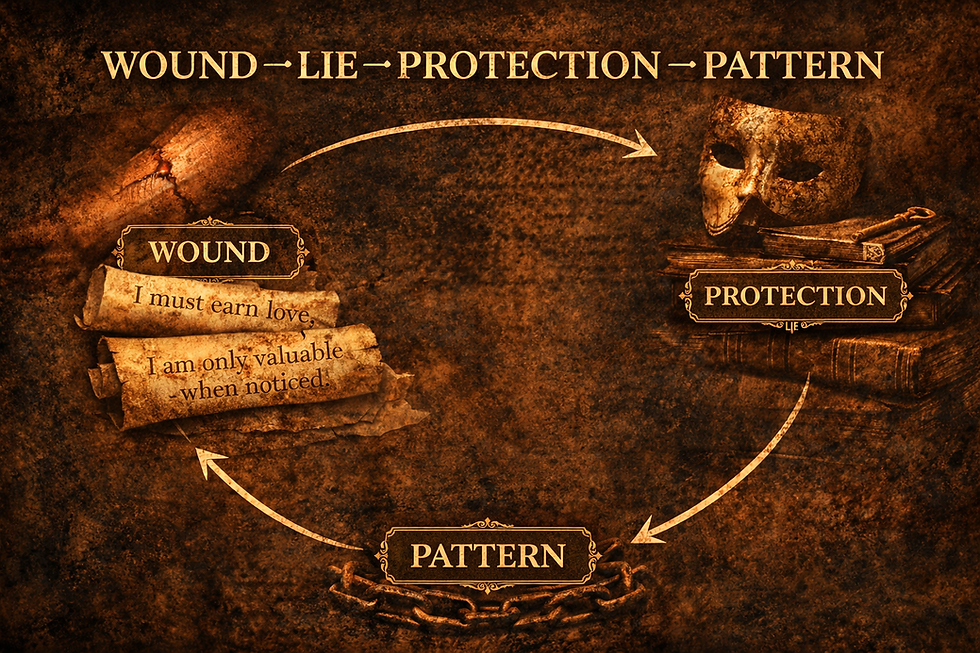
Narcissistic tendencies do not appear out of nowhere, they develop, grow, and are reinforced through this cycle. First, a wound takes place, such as rejection, where someone feels unwanted or dismissed. Common examples of wounds are shame, in moments where you begin to believe you are fundamentally flawed; neglect, where you are not emotionally seen or nurtured; or love that is only given when something is achieved. In those moments, the heart tries to make sense of the pain, and it forms internal conclusions or lies that feel true even when they are not. “I must earn love.” “I am only valuable when I am noticed.” These lies don’t stay in the mind alone; they begin to shape identity.
Next, protection rises as a response. The heart turns to self-focus, control, and performance to guard against being hurt again. What begins as a way to survive slowly becomes a way of living. Over time, protection becomes a pattern, and those patterns can take on the form of narcissistic tendencies, strongholds built not just from behavior, but from deeply rooted beliefs and agreements.
In many cases, these patterns also open the door to spiritual oppression, where the enemy reinforces the lie to keep the cycle in place. I believe it is crucial to know how we were formed so we can be transformed. Because what was learned in moments of emotional pain can be healed in the presence of God, and every place where a lie took root is an invitation for truth to set us free.
The Relationship and Spiritual Impact of Narcissism
When we live by the mirror and the mask, it inevitably shapes how we relate to others. Relationships begin to feel strained or shallow because they are no longer built on authenticity, but on self-protection. Empathy becomes difficult when the focus remains inward, and there can be a subtle need for admiration or control to maintain a sense of worth. Intimacy grows harder because vulnerability feels unsafe, and anything that threatens the image we have worked to uphold feels dangerous. Even simple feedback or correction can feel overwhelming, not because it is harsh, but because identity itself feels fragile or uncertain.
In this space, connection is slowly replaced with performance, and perception is built more on what is presented than what is true. Scripture reminds us that love “does not seek its own” (1 Corinthians 13:5), yet when the heart turns inward, relationships begin to revolve around self rather than genuine love and mutuality.
This pattern does not stop at human relationships; it reaches into our relationship with God. When our identity is not rooted in being a son or daughter, it will always default to performance. IN these moments, we will always begin to relate to God through what we do rather than who we are in Him.
Our spiritual lives can quietly shift into striving, where we measure closeness to God by our output rather than resting in His presence. Yet Jesus invites us into something different: “Abide in Me, and I in you… for without Me you can do nothing” (John 15:4–5). Apart from abiding, we move into self-reliance, and self-reliance always leads to striving. Instead of living as sons and daughters who cry out, “Abba, Father” (Romans 8:15), we can begin to live like servants trying to earn what has already been given.
The heart that was created for intimacy settles for activity, and the soul that was meant to rest begins to strive.
We see this clearly in the life of King Saul. God chose Saul, yet he never allowed his identity to be anchored in that truth. In 1 Samuel 15, Saul disobeys the Lord out of fear of people, later admitting, “I feared the people and obeyed their voice” (1 Samuel 15:24). His insecurity led him to compare himself with David (1 Samuel 18:7–9), to seek validation from others, and to make decisions rooted in image rather than obedience. He built both a mirror and a mask by remaining constantly aware of how he appeared, yet deeply unsettled within.
His need to maintain control ultimately led him away from trusting God, and what began as insecurity grew into disobedience.
Saul’s life shows us that when our identity is not secure, we will strive to protect it, even at the cost of intimacy with God. And this brings us to an important truth: if narcissism is rooted in protection, then healing will never come by correcting behavior alone; it must address the wound beneath it.
Prayer
Dear Heavenly Father, thank You for seeing beyond what I present and into the places I have tried to protect. You know every wound, every lie I have believed, and every pattern that has formed in response, and today I invite You into those places. Reveal by Your Holy Spirit any place where I have built identity apart from You; where I have lived by the mirror and hidden behind the mask and heal what has been wounded as You replace every lie with Your truth. Teach me to rest again as Your son/daughter, secure in Your love, in the places I have where I have protected myself, help me trust You, and where I have performed, teach me to abide. I choose to lay down the need to hold myself together and receive the identity You have already given me in Christ. In the name of Jesus, I pray. Amen.
Key Takeaways:
What looks like confidence may actually be protection. Not all strength is rooted in wholeness; some of it was formed in survival.
Narcissistic patterns are not random; they are formed. Wound → Protection → Pattern. What was learned in pain can be healed in God’s presence.
Healing begins with identity, not behavior. You don’t have to perform to be loved; you are already a son or daughter invited to rest in Him.
Reflection Questions:
Where in my life do I feel the strongest need to be seen, validated, or in control, and what might that be protecting?
What lies have I believed about my worth or identity that may have formed from past wounds?
What would it look like for me to shift from performing for acceptance to resting in my identity as a son or daughter of God?


Comments